
The .38 Special
Part 1: Clearing the Air on a Misunderstood Classic

When people argue against the .38 Special, they often reach for history first.
The Moro Insurrection gets brought up, usually as a kind of shorthand conclusion: The .38 “failed,” the military went back to the .45, and that eventually led to the 1911. It’s a clean story, alright. But it’s too clean.
The problem is the cartridge in question wasn’t the .38 Special at all. It was the .38 Long Colt.
That “little” detail often gets conveniently ignored much more often than it should.
The .38 Long Colt was a black powder era holdover that was limited by its design. Light bullets for its caliber, modest velocities, and a case that simply didn’t have much room to grow. In service revolvers of the time, it was typically pushing a 150 grain round nose lead bullet at roughly 700–750 fps. Not helpless, but not impressive either, especially under extreme conditions where reliability of effect mattered more than paper ballistics.
The .38 Special was a different answer to the same general problem. It showed up a few years later with a longer case and more internal capacity, designed from the ground up to take advantage of better powders and higher pressures.
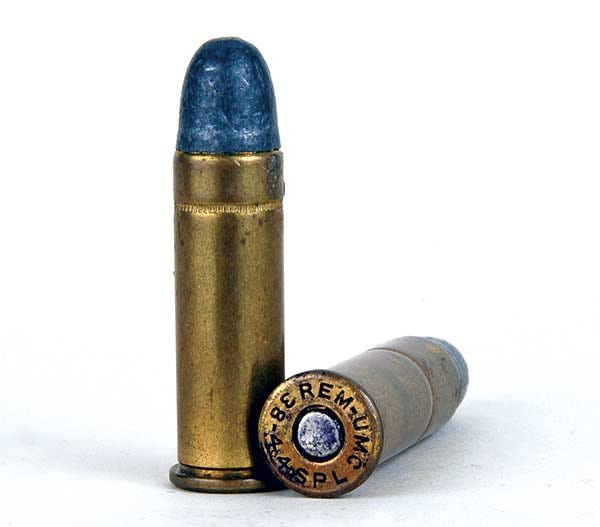
Originally loaded with 21 grains of FFFg black powder, S&W switched to modern, cleaner smokeless powder within a year of launch.
It wasn’t a revolution on day one, but it had headroom. That’s the key difference people miss when they simplify both cartridges into “.38 caliber revolver ammo.”
One was already at its ceiling. The other was just getting started and that’s why the .38 Special has survived every obituary written for it.
In a modern context, the .38 Special is less a single load and more a spectrum.
At the mild end, you have standard pressure target loads, wadcutters and soft shooting round nose ammunition that make long practice sessions easy. These are the loads that let people actually train without having to deal with much recoil, which is more important than it sounds when you’re talking about defensive skill.
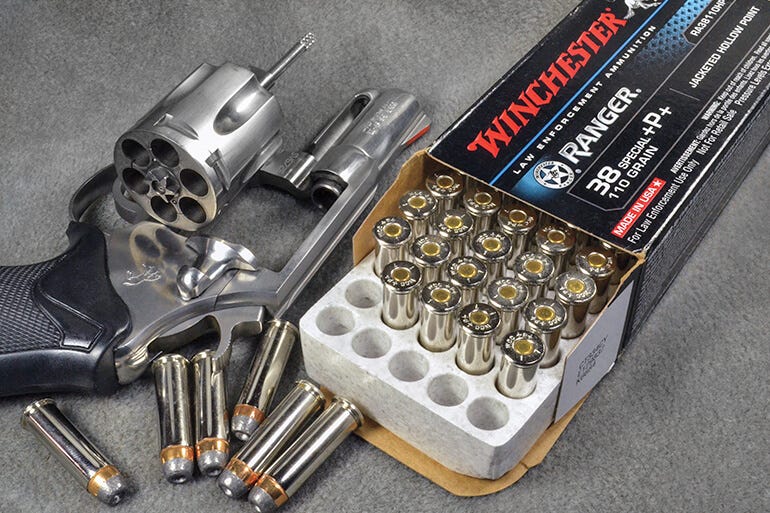
Step up from there and you get +P ammunition. Same cartridge, higher pressure, and in many cases dramatically better terminal performance, largely in part to modern bullet design. Controlled expansion hollow points have changed what the .38 Special can realistically do in a defensive role compared to its mid 20th century reputation.
And then there’s the gun itself, which is where the versatility of the cartridge really comes to light.
In a lightweight snub nose revolver, the .38 Special is all about control in a very small package. Recoil is sharper, sight radius is short, and performance is by affected by barrel length, but it remains usable, which is the entire point of that category of firearm.
Move the same cartridge into a 4 inch steel revolver and everything smooths out. Velocity increases. Recoil softens. Accuracy tightens up. The cartridge doesn’t change, but the environment around it does, and the result is a noticeably more capable system.
Barrel length matters more than most people expect with .38 Special. A 2-inch snub can give up 10 - 15% of velocity compared to a 4-inch service revolver, and that's enough to affect reliable expansion with some hollow point designs. That’s not a flaw in the cartridge; it’s just internal ballistics doing what they always do. The same round behaves differently depending on how much barrel it gets to work with.
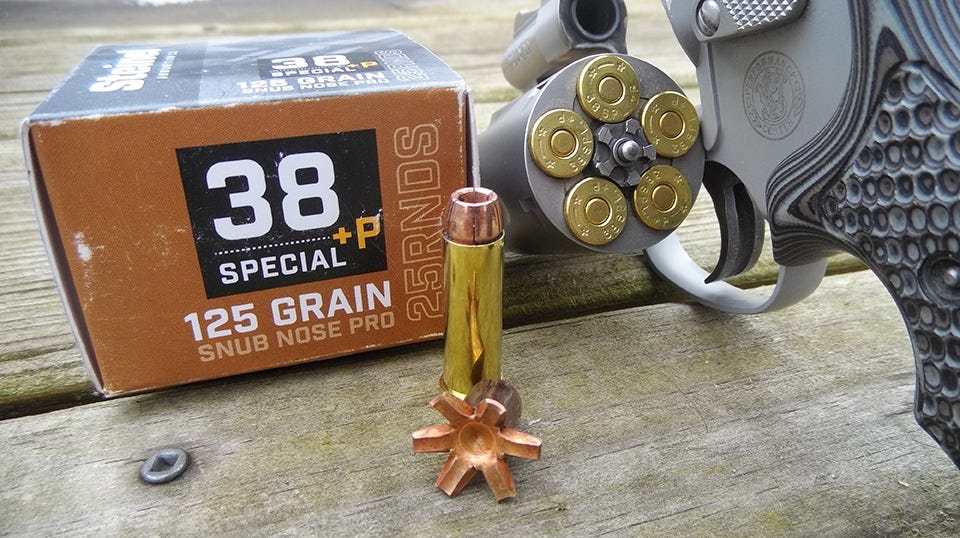
This is where modern defensive load development has reshaped the conversation. Today’s best .38 Special loads are designed specifically with those shorter barrels in mind. Softer expansion thresholds, bonded or mechanically locked jackets, and bullet profiles tuned to perform at lower velocities than older designs required. In other words, the cartridge adapted rather than being replaced.
That’s what gets overlooked in the “it’s outdated” argument. Outdated compared to what, exactly? Compared to itself in 1955? Or compared to magnum cartridges that were designed for entirely different recoil and platform expectations?
The .38 Special survives because it occupies a very specific space that hasn’t disappeared: a controllable, accurate, widely available revolver cartridge that can be mild for training and still effective for defense when loaded appropriately.
To be continued...
Great article and I heartily agree with you. I have carried a 38 special since I first pinned on a badge in 1973. I am comfortable as the 38 special will still do everything I need it to do as long as I do my part.
I enjoyed reading this. It's very similar to my thoughts on my favorite platform the semi automatic. I just like the extra rounds and easier reload. A few years ago though I got to thinking about my ballistics. I carried a 40sw 165 grain speer gold dot. Solid very accepted self defense round. In the 411 to 420 ft lb range it was significant step up from then current 9mm rounds. I thought it was a very good middle of the road, better than 9mm but not as expensive as 10mm or 45auto.
I now carry all copper 60gr rounds that are 533 ft lbs of energy. Modern tech and ballistics have given the 40sw a 25% increase in muzzle energy and almost double the velocity. I had been looking at moving to a different gun and ammo to give lighter recoil with low end rifle velocity out of a pistol. New technology meant that all I had to do was purchase new ammo. Keep the same gun, magazines and holsters but step up to new performance. It also dropped about a pound off my belt between loaded gun and spare magazines.
Today I have moved down to 9mm because of age induced weaker hands and arms and to have a even smaller lighter gun and magazines. I'm still getting 462 ft lbs of energy at the muzzle.
I looked up their ammo for 38sp and it was puzzling. 250ft lbs at the muzzle. Standard loads run from 200 ft lbs to 350ft lbs already. I would be very curious why most calibers get a very substantial increase in energy while the 38sp is so anemic with their (liberty ammunition's civil defense) ammo.
9mm 462 FPE 2040 FPS
38sp 250 ft lbs 1500 FPS
380auto 250 ft lbs 1500 FPS
40sw 533 ft lbs 2000 FPS
10mm 780 ft lbs 2,400 FPS
357 magnum 490 ft lbs 2100 FPS
357 sig 587 ft lbs 2300 FPS
45 acp 600 ft lbs 1900 FPS
all I can think is that it has to do with sami specs for chamber pressures. Admittedly with the light weight of the bullets (between 50 and 78 gr. 78 for 45acp and all other 50 and 60 gr) there isn't a huge difference in bullet weight. So keeping the muzzle velocity down on the 38sp and 380 auto seem to be aimed at reducing chamber pressure.
:) now I will add this since these bullets really seem to hit that new stuff bad bone that a lot of us have over changing tried and true rounds for newer vastly different ones. Just about every time I post about these bullets I hear about how they don't have the penetration of ones like the speer gold dot. With it being closer to 12 to 14 inches than 19 to 25 ish inches. That is one of my likes for this round. We are not like cops that get a pass if a bullet goes through our target and hits someone else. With more energy on impact at close range and less penetration I am at a trade off I like. Also there are 5 different wound channels compared to one with standard rounds.
They do make a new Overwatch 9mm round that has deeper penetration comparable to the older school ammo and a 473 ft lbs muzzle energy. I guess it was at the request of military that they developed it at least that is what is on their webpage. it has a 72 gr bullet compared to 50gr for the civil defense which also lowered muzzle velocity to 1700 FPS.
this just all ties back into the article here. Newer and divergent upgrades in tech for bullets keeps older platforms relevant and comparable to more modern calibers/guns.
Ballistics and terminal ballistics are some fascinating subjects.